Introduction to SQL
- Query databases using SQL
- Filter, limit, and organise query results using SQL
- Employ concatenation, Boolean expressions, and wildcard characters in queries
- Apply `WHERE` clauses with `AND` and `OR` operators to filter database queries
- Implement the use of `IN`, `NOT IN`, `IS NULL`, and `BETWEEN` operators in queries
- Use `ORDER BY`, `LIMIT`, `DISTINCT`, and column renaming to manipulate query results
- Combine data from multiple tables using `JOINs` (especially `INNER` and `LEFT`)
Pre-work
Database creation
Download and run the setup_streaming_db script.
Check that you can connect to this database using psql.
Exploration
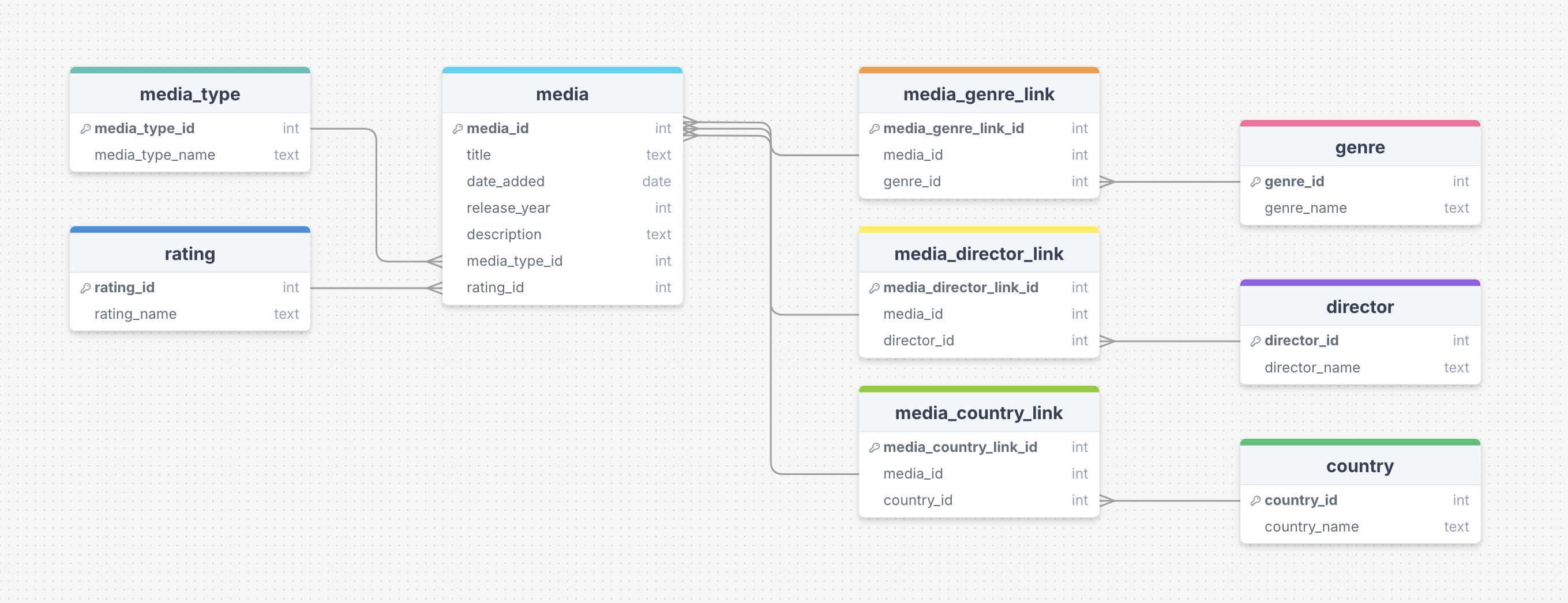
Examine the below ERD carefully; how do the different tables connect? What does each table contain?
Workshop
Database setup
Download the setup_streaming_db.sql file.
Show trainees the setup_streaming_db.sql file and the streaming_erd; talk through the general structure.
Explain that psql can be used to run commands from a .sql file.
psql postgres -f setup_streaming_db.sql
Explain that this has created a new database on your local machine.
Get trainees to walk you through the process of connecting to the new database and exploring the basic structure.
psql streaming
\dt
SELECT * FROM country;
Syntax
Ask trainees how you would see just the titles of all media.
SELECT title FROM media;
Complicate the query steadily, adding new syntax as appropriate.
Encourage the trainees to guide you and explain the syntax as you write it.
Include
WHEREto filter resultsORDER BYto change the order of displayed rulesLIMITto display only a certain number of resultsMIN()andMAX()to aggregate results||as the concatenation operator
Highlight to trainees that these key words can be combined together to produce complex behaviour, but that the order of keywords is fixed. WHERE comes after FROM, and LIMIT is always at the end.
Challenge
Challenge trainees to write queries for the following:
- The number of movies have the word 'love' in the title
- The number of shows have the word 'romance' in the description
- The first five movies in the database, displayed as
Title (year of release)
Joins
Introduce the JOIN keyword as a way to combine tables together
SELECT title, media_type
FROM media AS M
LEFT JOIN media_type AS MT
  ON (M.media_type_id = MT.media_type_id)
;
Demonstrate that this allows you to access data from both tables, matched across by
Stress that, like all SQL keywords, JOIN is compositional; multiple tables can be JOINed together simply by stacking the keyword.
SELECT title, media_type
FROM media
LEFT JOIN media_type
  USING (media_type_id)
LEFT JOIN rating
  USING (rating_id)
;
Challenge
Divide the trainees into pairs.
Challenge them to find answers to the following questions:
- How many movies were made in 2019?
- What's the earliest a TV show about vampires was added to the service?
- How many directors have an A in their first name?
- How many movies were added to the service in the same year they were released?
- How many shows available in the US have a director with the first name of John?
Gather trainees back together and discuss solutions.
-- 1. How many movies were made in 2019?

SELECT COUNT(*)
FROM media as M
JOIN media_type as MT ON M.media_type_id = MT.media_type_id
WHERE MT.media_type_name = 'movie' AND M.release_year = 2019;


-- 2. What's the earliest a TV show about vampires was added to the service?

SELECT MIN(M.date_added)
FROM media as M
JOIN media_type as MT ON M.media_type_id = MT.media_type_id
WHERE MT.media_type_name = 'show' AND M.description ILIKE '%vampire%';


-- 3. How many directors have an A in their first name?

SELECT COUNT(DISTINCT D.director_id)
FROM director as D
WHERE SPLIT_PART(D.director_name, ' ', 1) ILIKE '%a%';


-- 4. How many movies were added to the service in the same year they were released?

SELECT COUNT(*)
FROM media as M
JOIN media_type as MT ON M.media_type_id = MT.media_type_id
WHERE MT.media_type_name = 'movie' AND EXTRACT(YEAR FROM M.date_added) = M.release_year;


-- 5. How many shows available in the US have a director with the first name of John?

SELECT COUNT(DISTINCT M.media_id)
FROM media as M
JOIN media_type as MT ON M.media_type_id = MT.media_type_id
JOIN media_country_link as MCL ON M.media_id = MCL.media_id
JOIN country as C ON MCL.country_id = C.country_id
JOIN media_director_link as MDL ON M.media_id = MDL.media_id
JOIN director as D ON MDL.director_id = D.director_id
WHERE MT.media_type_name = 'show'
  AND C.country_name = 'United States'
  AND SPLIT_PART(D.director_name, ' ', 1) ILIKE 'john';