[Optional] Performance Optimisation
- Understand Big O notation and its relevance to code evaluation
- Analyse code to determine its time complexity
- Recognise when performance optimisation matters versus when it does not
- Apply knowledge of data structure efficiency to improve solutions
Workshop
Discuss
Explain briefly context for the workshop
- When you build systems, like backend APIs, you'll very possibly need to think about speed: "Why is this slow?" or "Can we handle more requests?"
- Big O notation gives you a common language to use when optimising performance. It gives you a specific way to talk about the complexity of your code in terms of speed (time) and size (memory)
Ask trainees to share their thoughts on performance optimisation
- What does it mean?
- How would we optimise performance?
- When does performance matter?
Guide them to understand that most code prioritises readability and correctness before speed. Premature optimisation is a common pitfall.
Introduce Big O notation as a way to talk about code efficiency without having to run it every time to directly measure.
Big O notation describes how the runtime (or space) of an algorithm grows relative to its input size. It lets us compare efficiency between different approaches to the same problem.
Cover the Big-O notation, using the following examples.
Big O notation describes the complexity of code in algebraic terms.
O(1)
Constant time. Will always take the same amount of time.
myArray = ['Sigma', 'Labs', 'XYZ']
myArray[0]
This is O(1). It will always take the same amount of time to look up an array index.
O(n)
Linear time. The time is directly proportional to number of inputs. A for loop is O(n) as it is directly proportional to the number of iterations.
myArray = ['Sigma', 'Labs', 'XYZ']
for i in range(len(myArray)):
    print(myArray[i])
O(n^2)
Quadratic time. The time is proportional to the square of the input size. Nested for loops are an example of quadratic time.
for i in range(len(myArray)):
    for j in range(len(myArray)):
        print(myArray[i])
O(log n)
Logarithmic time. The time is proportional to the log of input size n. Binary search is an example of O(log n)
def binarySearch(array: int, targetValue: int) -> int:
    minIndex = 0
    maxIndex = len(array) - 1
    currentIndex = None
    currentElement = None
    while minIndex <= maxIndex:
        currentIndex = ((minIndex + maxIndex) / 2) | 0
        currentElement = array[currentIndex]
        if currentElement < targetValue:
            minIndex = currentIndex + 1
        elif currentElement > targetValue:
            maxIndex = currentIndex - 1
        else:
            return currentIndex
    return -1 #If the index of the element is not found.
Share this graph with the trainees to demonstrate how the different complexities compare
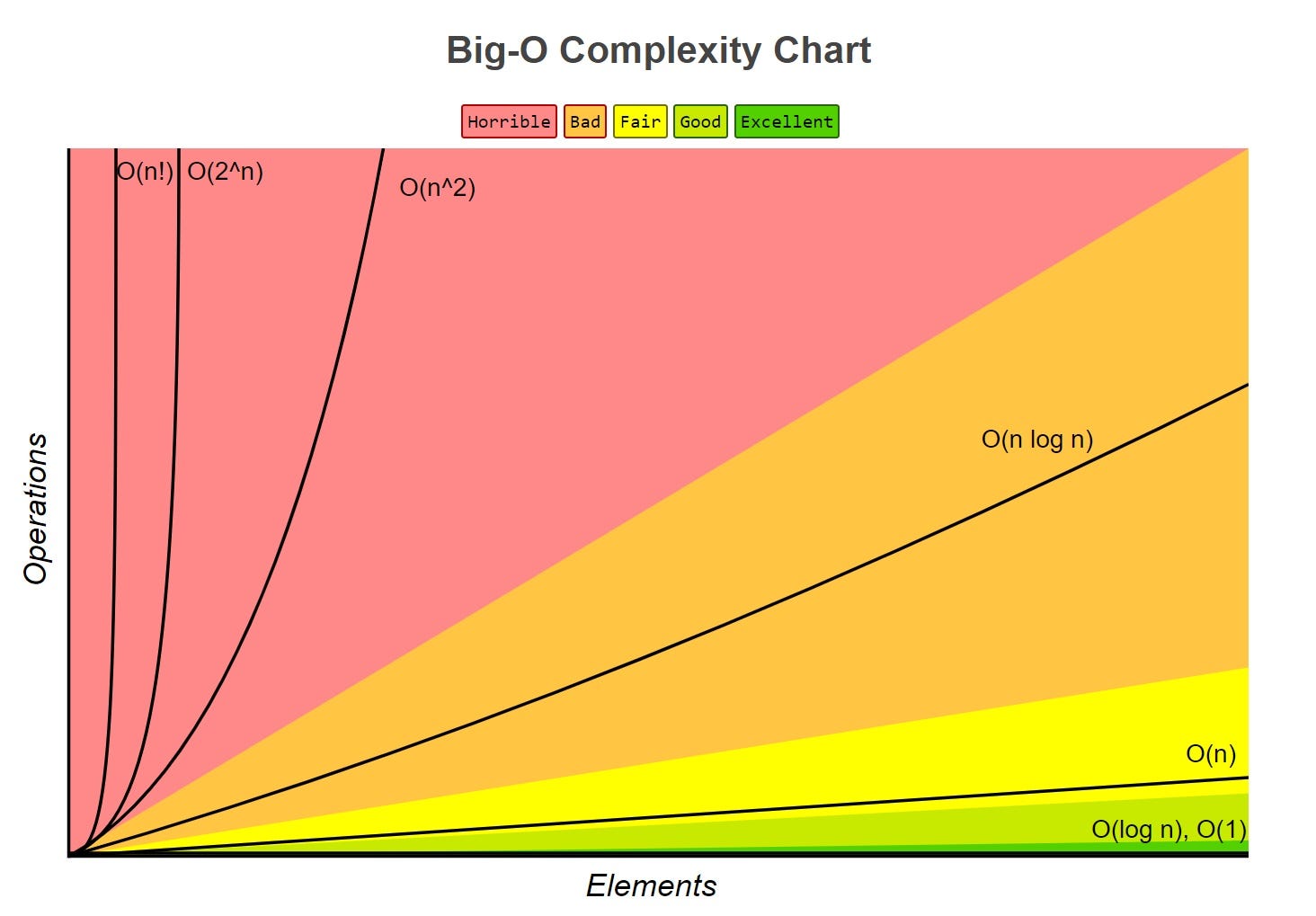
Share the following cheat sheet for how efficient different data structures are

Reflection
Remind trainees of the hierarchy:
- Working code
- Clean code
- Performant code
Emphasise that you should only optimise once you've achieved the first two. In most real-world projects, the difference between O(n) and O(log n) is irrelevant if the data set is small.
Stress that readable, correct code is almost always better than fast, confusing code.